Halloween Is a Treat for Speech and Language Development!
Five simple ways to support your child's speech, language, and social communication this Halloween, plus a trick-or-treat social story handout.
Halloween is full of excitement, costumes, decorations, and, of course, candy! But did you know that trick-or-treating is also a wonderful opportunity to support your child’s speech and language development?
Whether your child is just beginning to use words, putting together short phrases, or practicing conversations, Halloween offers lots of natural opportunities to build communication skills.
The best part? You don’t need special toys. Everyday Halloween activities provide plenty of opportunities to learn through play and real-life experiences.
Here are five simple ways to support your child’s speech and language development this Halloween.
1. Build Vocabulary with Halloween Fun
Halloween is full of exciting things to see and talk about. Costumes, pumpkins, ghosts, bats, candy, and decorations all provide opportunities to introduce new words.
Remember that children learn language through hearing words used naturally and repeatedly. You don’t need to quiz your child or expect them to repeat every word. Simply talking about what interests them helps build vocabulary.
2. Expand Your Child’s Language
When children are learning to talk, they often communicate using single words or short phrases. You can support language development by adding a little more information to what your child says.
For example:
Build on your child's words
- Child: "Candy!"
- Adult: "You got candy!"
- Child: "Big pumpkin."
- Adult: "That's a big orange pumpkin!"
- Child: "Ghost!"
- Adult: "I see a spooky ghost!"
- Child: "More!"
- Adult: "You want more Halloween stickers."
This strategy, often called language expansion, gives children examples of slightly longer and more complete phrases without requiring them to repeat after you.
You can also model early grammatical concepts throughout the evening:
- Action words: “The skeleton is dancing.”
- Plurals: “I see two bats.”
- Pronouns: “He is wearing a cape.”
- Prepositions: “The candy is in your bag.”
Follow your child’s lead and build on what they are already interested in saying.
3. Practice Speech Sounds Naturally
Halloween provides lots of fun words for children who are working on speech sound development. Depending on your child’s goals, you might practice words such as pumpkin, candy, spider, ghost, bat, or witch.
Here are a few ideas:
- Play “I Spy” with Halloween decorations.
- Name the items you see while walking around the neighborhood.
- Practice a target word during pretend trick-or-treating.
- Read a Halloween book together and notice words that contain your child’s target sounds.
4. Make Trick-or-Treating a Social Communication Adventure
Trick-or-treating involves many social communication skills, from greeting neighbors to waiting for a turn. These skills may come naturally to some children, while others benefit from practice and support.
Before heading out, practice a few common interactions:
- Saying “Trick or treat!”
- Saying “Thank you.”
- Waving or greeting a neighbor.
- Waiting while another child receives candy.
- Asking for help when needed.
Not every child will communicate in the same way. A child might use spoken words, gestures, a communication board, or a speech-generating device. All of these can support meaningful participation.
You can also prepare your child for what to expect. Talk about walking to a door, waiting, receiving candy, and moving on to the next house. A simple visual schedule or social story can make the routine more predictable and help children feel more comfortable and confident.
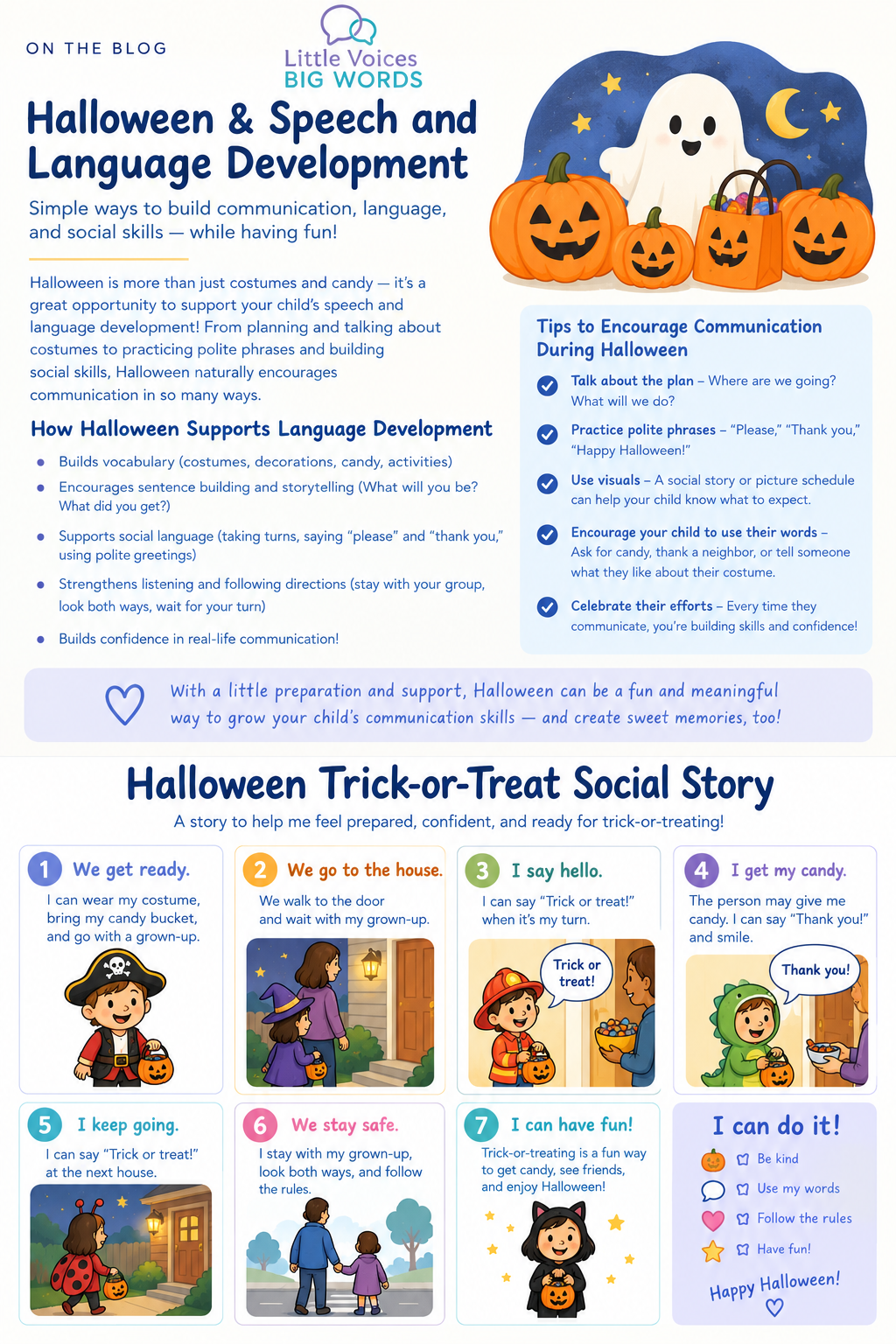
Check out this Halloween handout featuring our Halloween Trick-or-Treat Social Story to help prepare your little ones for the big night! Read the story together in the days leading up to Halloween. You can talk about the pictures, practice phrases such as “Trick or treat!” and “Thank you,” and personalize the experience to reflect your child’s plans.
Halloween Trick-or-Treat Social Story
Remember that the goal isn’t perfect social interactions. It’s helping your child feel prepared, communicate in ways that work for them, and enjoy the experience.
5. Use Halloween Play to Encourage Conversation
Pretend play is a wonderful way to practice language before the big night. Set up a pretend trick-or-treating game at home using a bag, a few pieces of pretend candy, and some stuffed animals or family members.
During play, you can model:
- Asking questions: “Where should we go next?”
- Answering questions: “What is in your bag?”
- Making comments: “Wow, you got a chocolate bar!”
- Taking turns: “It’s your turn to knock.”
- Describing events: “First we knock, then we say trick or treat.”
Follow your child’s interests and allow them to direct the play. You can model new words, phrases, and questions while keeping the activity fun and low-pressure.
A Few Extra Tips for a Communication-Friendly Halloween
Keep expectations realistic. Excitement, noise, costumes, and changes in routine can make communication more challenging.
Practice ahead of time. A social story, pretend play, or a quick walk-through of the routine can help children feel more prepared.
Offer choices. “Do you want the pumpkin bucket or the ghost bag?” gives your child a natural reason to communicate.
Accept all forms of communication. Spoken words are only one way to communicate. Gestures, signs, pictures, and communication devices all count.
Follow your child’s lead. Some children love visiting lots of houses, while others prefer a shorter route or a quieter Halloween activity at home.
The Takeaway
Halloween doesn’t need to become a language lesson. The most valuable learning often happens when you follow your child’s interests, model language naturally, and enjoy the experience together.
Whether you’re carving a pumpkin, reading a Halloween book, or heading out to trick-or-treat, you have plenty of opportunities to support your child’s communication in ways that feel fun and meaningful.